However, there is an additional factor, which I believe would have hindered China in many ways in the upcoming centuries, and that factor is its writing system:
I believe that even if China did emerge as a dominant power in the XV century, alongside Europe, they would have still had trouble developing, in particular in the realm of science. I will speculate that the Scientific Revolution would have had a much more difficult time arising in East Asia. Why is that?
Compared to the Latin alphabet in Western Europe, the Chinese writing system is considerably more complex, which has disadvantages in at least the following areas:
- Memorizing hieroglyphs requires a lot more time and effort than memorizing a simple alphabet of 24-40 letters. This means it takes longer for children and illiterate people to learn, and makes high literacy rates more difficult.
- Hieroglyphic writing is by its nature resistant to loan words from other languages.
- Hieroglyphic writing takes slower to adopt new concepts into the writing system, because it requires an invention of a new character every time. This has the consequence that ideas from other languages will be adapted slower, as they have to go thru the artificial filter of the writing system.
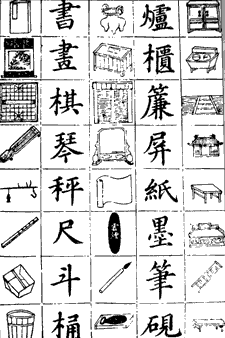
- The Chinese hieroglyphs in particular have been excessively stylized to the point where they hardly resemble the objects they were supposed to represent, even in the simple case (illustrated by the picture at the beginning of the post).
- Hieroglyphic writing has further promoted elitism, has warped the concept of what it means to be educated, and has created a lot of waste in the educational system. Thus the focus was placed on learning the characters at the cost of the knowledge behind them.
- Up until the XX century, much of the mentality around education in the East Asian countries has been along the lines of "I know more fancy characters than you, therefore I am more intelligent".
- The emphasis has not only been on memorization of the characters themselves, but also the proper way to write them, including the direction and the thickness of each stroke!
- In Korea, even though they invented a truly phonetic alphabet in the XV century, it was considered low-class for "weak" people who couldn't read the real writing (the original Chinese). It was called "women's script" or "children's script".
- Similar things happened to the syllabaries of Katakana and Hiragana in Japan, which were not widely accepted by the elites, instead utilized by women, who did not have access to "proper" education.
- There was a proliferation of obscure poetic paradigms, such as the Chengyu, the four-character idioms, which have a different meaning than what is directly implied by the characters they contain. While useful for poetry, and abstract expression, from the point of view of illustration of concrete concepts and hard sciences, this is just another digression.

Europe's well-established alphabetical system allowed for quick transfer of ideas, and made introduction of new terms easy, which I believe is one of the main reasons the Scientific Revolution happened in Europe and not in Asia.


1 comment:
P.S. An important question has been raised to me a few times in relation to this post: "What about the Japanese? They seem to be doing alright these days". It is important to recognize that Japan's success largely depended on quickly adopting European inventions, such as handguns and railroads. In the XIX century they quickly recognized this strategy was in their best interest, and cashed in on it tremendously. The other Asian countries have also modernized themselves rapidly in the recent decades. But the key point from this post still stands. The Scientific Revolution developed in Europe, and not in Asia.
Post a Comment