Sunday, January 27, 2008

The God Delusion: part 3 (Creation of the Universe)

One of the arguments, most frequently raised by theists, goes something like this.
  • We, human beings, are here.
  • Therefore the conditions at the beginning of the universe must have made it possible for us to exist. I.e. the physical constants in the universe are fine-tuned in such a way as to make life possible. A small change in almost any one of those constants would have made life impossible.
  • Therefore, someone (God) must have known how difficult it would be, and must have made sure we exist by fine-tuning the physical constants this way.


Creation of the Universe
(actual footage of the moment)


Suppose it is true, that the current combination of physical constants is indeed in a very narrow band of values which ultimately makes life possible. Also suppose for my personal amusement that God exists. What does this actually imply about Him and the Universe that he's created?
  • First of all, it's a bit of a boring job for the Almighty to be sitting around turning some dials on a Tuner. Do you really think God had nothing better to do than to play around with his Physics Constant Tuner until he came up with the perfect combination?
Physical Constants Tuner (drawn to scale)

  • Secondly, couldn't God just circumvent the laws of physics to make sure that life is there despite a bad combination of physical constants? An omnipotent being shouldn't be constrained by such silliness as laws of the universe, if he could control all atoms individually.
  • Thirdly, what makes the existence of the human race so special anyway that somebody had to design the universe just for that purpose? If God wanted life, wouldn't he make sure it exists on more than just a tiny spec among millions of stars and planets? For evidence of design, I would need to see the universe boiling over with intelligent life everywhere! The way the universe looks now (our intelligent life is very much isolated, at least in this corner of the Universe), makes me wonder if maybe God didn't just intend to create the rings of Saturn!
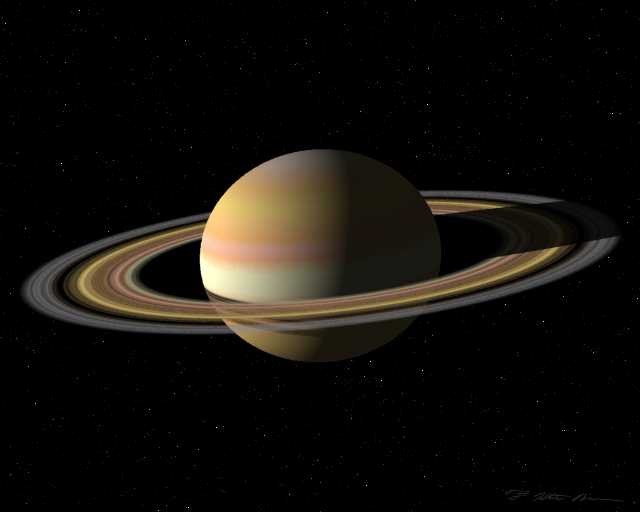
The Rings of Saturn. God's ultimate creation.
  • I think he played around with the Physical Constants Tuner until he came up with a combination of physical constants that would make the rings of Saturn possible, and then realized "Whoops! Now I have to deal with this whole life thing, especially all those annoying humans praying to me. Why can't they just leave me alone to marvel at what I have created? I don't have time for this shit!"
  • Finally, the theists assume that God is the only possible explanation for why the universe is the way it is right now. Of course it is not. Dawkins proposes a few alternative explanations around p. 175 of The God Delusion. Most of these alternatives boil down to the following theory: our universe is just one of many, most of the other universes do not support life, but this one does. Of course this theory is just about as unprovable as the existence of God. We have almost no way to test it, but there is a fundamental difference: the theory of multiple universe doest not have the unnecessary romantic component, where we have to make the assumption that we are special. Dawkins also talks about how it is quite likely there are other biological life forms elsewhere in the universe, which makes our existence even less special or unique.

Tuesday, January 22, 2008

The God Delusion: part 2

Well, I wasn't really going to address the arguments for and against God here, because this blog is not really about religion. But since there seems to be an interest in the discussion, and it used to be one of my favorite subjects, I'll gladly go into it for the sake of my pious brother in New Zealand, Mr. Mackie.

To Mr. Mackie's credit, he summarizes the arguments of The God Delusion very well, and has a very good understanding of what Dawkins is trying to say. So luckily we won't have to debate about the content of the book itself, and focus instead on the facts, the arguments and the conclusions. Is there a God after all?


Let's forget about what we mean by God for a bit, because it's just going to drag on for too long. Just read the first couple of chapters of Dawkins' book or Mr. Mackie's post, and you'll be well primed on all the definitions.

There are many many arguments for the existence of God, and the vast majority of them are easily dismissed. But there are a few fundamental questions, seemingly related to the existence of God that do deserve special attention.
  1. How did the universe begin?
  2. How did life begin?
  3. How did life get to the point where we are now?
The main point of the pro-religion camp, including Mr. Mackie goes like this:
  • Science can't explain X
  • OK, it can explain a lot of things about X, but it cannot explain everything
  • => Therefore God exists
or:
  • There is a very low probability of the universe being the way it is
  • There is an even lower probability of life on earth being the way it is
  • => Therefore God exists
The fundamental flaws in the reasoning above are of course that
  • Science CAN explain quite a lot, and there's less and less room left for God to fill
  • Even if science fell short of explaining something, the existence of an omnipotent being is not the only alternative explanation
  • OK, after some magical calculations, you've established there is a God (somebody help me with a Bayesian formulation here). What is the probability of God's existence anyway, and who is His creator? The God Hypothesis requires further explanation, you can't just stop there!
I'll talk about the creation of the universe and evolution in the upcoming posts, stay tuned.

EDIT: one more issue I want to address is the pro-God argument from beauty and complexity:
  • If you look at a beautiful painting that takes your breath away, would you think it just came together by itself? You would naturally assume there is a creator!
  • If you look at the complex machinery of an airplane, and behold the miracle of flight, you would also have to assume that someone made it, and it didn't just happen
  • Then how can you look and the beautiful and complex universe of ours and say there is no God? You think the world just came together to its current form?

Sunday, January 13, 2008

"The God Delusion" first impressions

I have just started reading the latest book by Richard Dawkins called The God Delusion. The title speaks for itself, the book is an all out attack on organized religion as well as the concept of God or any kind of supernatural being. So far the arguments have been pretty solid, and the tone unapologetic, never sparing ridicule in places where it is deserved, Dawkings making good use of metaphors as he goes along.
As I continue reading the book, I'll be looking for answers to the following questions (some of which Richard Dawkins may not address):
  • Why if God is a delusion, has religion been such a significant force in human history?
  • How did religion come about in the first place?
  • Did other hominid species / homo sapiens predecessors have religion? If so, what forms did it take?
  • Did religion arise first as a device for individual comfort or as a device to control the masses from the top?
  • What evolutionary advantages did religion provide in the early days of humankind?
  • Why did religion tend to evolve from polytheistic to monotheistic in most areas of the world?
  • Why is there a trend for more secularism / atheism now?
  • Why is the US the most religious country in the First World

So far for me, one of the most enlightening things about the first few chapters of the book has been quotes from the American Founding Fathers, Einstein, and a few other historical figures that indicate their atheism. The following quotes shed a different light on the people we normally like to think of as religious.

It was, of course, a lie what you read about my religious convictions, a lie which is being systematically repeated. I do not believe in a personal God and I have never denied this but have expressed it clearly. If something is in me which can be called religious then it is the unbounded admiration for the structure of the world so far as our science can reveal it. - Albert Einstein

The idea of a personal God is quite alien to me and seems even naive.
- Albert Einstein

So the interesting point here is that contrary to popular belief, Einstein was not a religious man. Despite his frequently quoted statement about God playing dice with the universe, apparently he meant the word God in a poetic way, as a synonym to nature, and not in any mystical, supernatural sense.

The second interesting series of quotes comes from the founding fathers:

As the Government of the United States of America is not, in any sense, founded on the Christian religion; as it has in itself no character of enmity against the laws, religion, or tranquility of Musselmen; and as the said States never have entered into any war or act of hostility against any Mehomitan nation, it is declared by the parties that no pretext arising from religious opinions shall ever produce an interruption of the harmony existing between the two countries. - George Washington and John Adams, treaty with Tripoli


To talk of immaterial existences is to talk of nothings. To say that the human soul, angels, god, are immaterial, is to say that they are nothings, or that there is no god, no angels, no soul. I cannot reason otherwise ... without plunging into the fathomless abyss of dreams and phantasms. I am satisfied, and sufficiently occupied with the things which are, without tormenting or troubling myself about those which may indeed be, but of which I have no evidence. - Thomas Jefferson

Fix reason firmly in her seat, and call on her tribunal for every fact, every opinion. Question with boldness even the existence of a God; because if there be one, he must more approve of the homage of reason than that of blindfolded fear. - Thomas Jefferson

The interesting point is, yet again, contrary to popular belief, the United States of America was NOT founded as a Christian nation. In fact just about all the founding fathers were as atheist as they could be for their time, and wished for a secular state. Quite an eye-opener.